
It's talked about a lot, often incorrectly. Oxidative stress plays a real role in hair aging. Here's what science establishes, and what it cannot yet confirm.
Oxidative stress has become a buzzword, often brandished without being explained. Yet it is a real, studied mechanism that contributes to skin and hair aging. Here's what we can say about it rigorously, and where certainty ends.
Quick answer
Oxidative stress refers to an imbalance between continuously produced reactive oxygen species and the body's antioxidant defenses. Reference works indicate that it plays a major role in hair aging, with a decrease in the function of pigment cells, graying, and a weakening of production. Its main external sources are UV, pollution, and tobacco. Reducing these exposures and protecting the skin are coherent levers, although no cosmetic product can promise to reverse aging.
"Understanding a mechanism does not mean promising to cancel it. It means acting more precisely."
01Oxidative stress, clearly explained
Our body continuously produces reactive oxygen species, resulting from its normal functioning and numerous external aggressions. In parallel, it has antioxidant defenses. According to reference works, with age, the production of free radicals increases while these defenses decrease: this imbalance is called oxidative stress, and it contributes to the aging process.
02Its role on hair and follicles
Regarding hair, the aging phenotype manifests as a decrease in the function of pigment cells, leading to graying, and a decrease in production, associated with thinning. A more recent review also indicates that lipid peroxides can promote early entry of hair into the resting phase and apoptosis of follicle cells. These mechanisms are described as substantiated, while remaining complex biological processes.
03Its sources, and what we can do
The main external sources of oxidative stress described for hair are UV, pollution, and tobacco, to which internal factors such as the decline of antioxidant defenses are added. The consistent levers are therefore primarily those of common sense: protecting from the sun, limiting repeated aggressions, and taking care of skin balance. These are preventive measures, not promises of results.
Sorre's answer
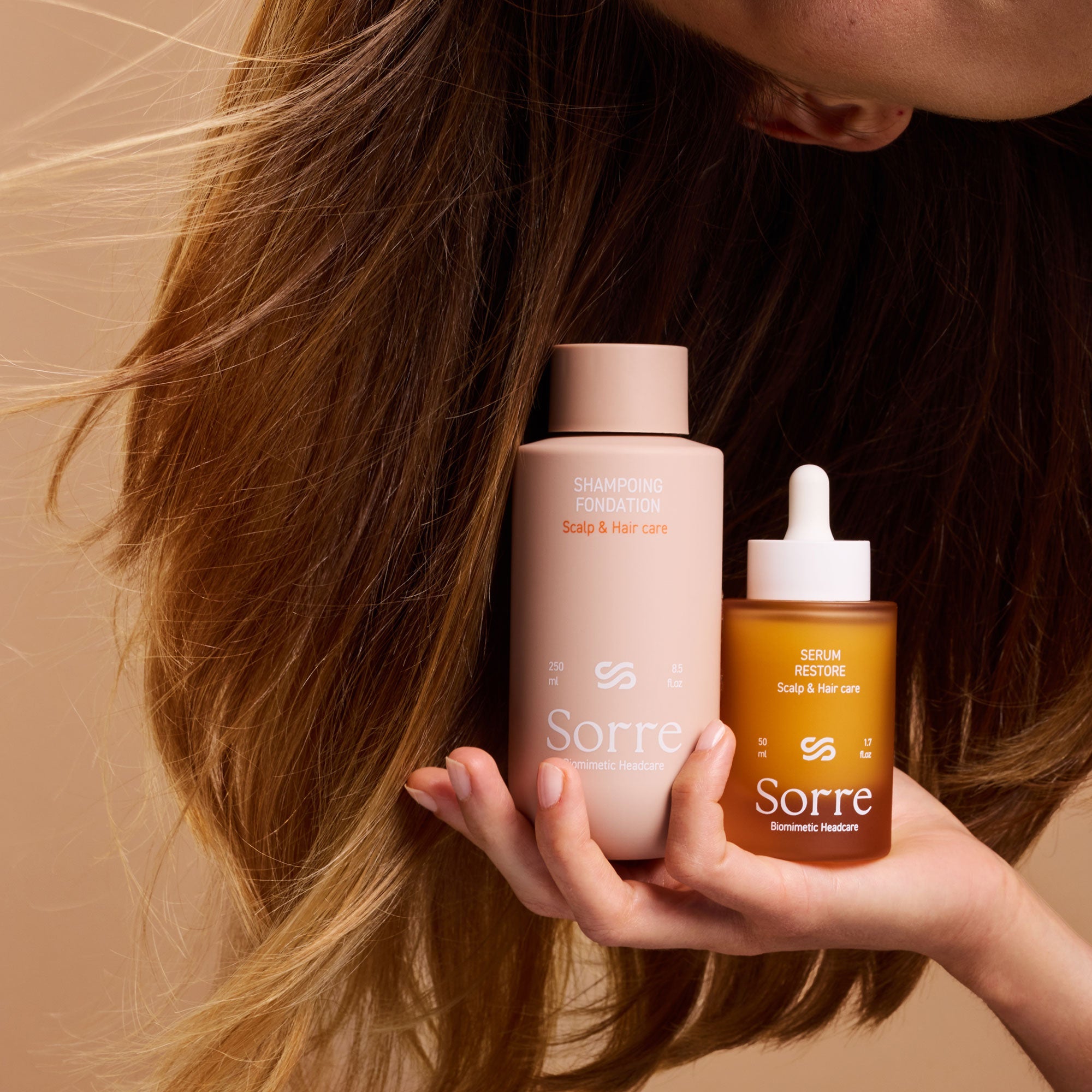
Our approach aims to support the skin's foundations over time, without promising to reverse aging, which no cosmetic can do. The Restore Serum targets hair loss: an instrumental test (counting by brushing and washing, once a day for 13 weeks) measured a 74% decrease in lost hair at 90 days, and 67% at 45 days (p<0.0001). Every benefit we claim is based on tests conducted on our finished formulas.

Scalp & Hair care · €67
Restore Serum
Formulated with our SCR-C4 complex, it targets hair loss. Efficacy measured on the finished formula.
Discover the treatment →To learn more: discover our clinical studies · the brand
In summary
Oxidative stress is a real imbalance that contributes to hair aging, from graying to thinning. Its main external sources are UV, pollution, and tobacco. We can act on prevention, by protecting the skin and limiting aggressions. But understanding a mechanism is not promising to cancel it: it is simply acting more precisely.
Sources & references
- Trüeb R.M. Oxidative Stress in Ageing of Hair. Int J Trichology, 2009;1(1):6-14. journals.lww.com
- Trüeb R.M. Oxidative stress and its impact on skin, scalp and hair. Int J Cosmet Sci, 2021. onlinelibrary.wiley.com
This article is for informational purposes only and does not replace medical advice.